A Complete Guide to Self Building with SIPs (Structural Insulated Panels) in the UK
If you’re a self builder looking to use SIP panels for your next project, you may have a lot of questions about the capabilities of our product.
With this handy guide, we aim to answer those questions – from SIPs capabilities and the initial design phase, all the way to the finishes on the completed building.
By the end of this guide, you’ll be better equipped to decide whether SIPs panels are the right choice for your next project.
What are Structural Insulated Panels (SIPs) and How Do They Work?
SIP (Structural Insulated Panels) are high-performance building materials made by sandwiching a rigid foam core – typically Expanded Polystyrene (EPS) – between two layers of structural grade panels of wood strands compressed with resin to form a material known as Oriented Strand Board (OSB)
SIP panels are a relatively new construction method. They’ve been in mainstream use for around 60 years, but have only recently started being used more in the UK building sector.
They’re an innovative product that combines high performance, incredible strength and durability, and eco-friendly materials, all while reducing labour costs, traditional build times and wastage on site. Using SIP panels, you can erect a house in 5 – 7 days.
What are the Advantages of Building with SIPs?
Due to their inherent design, SIP panels offer numerous advantages over traditional building methods such as timber or brick/block construction.
- 3x faster build time than with traditional build methods
- 90% less onsite wastage
- Eco friendly method of construction
- Can be constructed in any weather conditions
- Reduced labour costs onsite
- Less need for heavy machinery like cranes and drills
- Ideal for builds where space is at a premium
- High durability and long lasting lifespan
- Incredible energy efficiency
Now, let’s take a look at these in a little more detail.
3x faster build time than with traditional build methods
Building with SIP panels is around three times faster than with traditional methods, and self-builders can often find that a typical house built with SIP panels can go up in a week or less.
90% less onsite wastage
Building with SIP panels there’s around 90% less onsite wastage, as long as the finalised design is followed properly, and there are no amendments or external pressures.
This is because SIP panels are constructed off site and assembled onsite with ease.This also reduces traditional onsite costs, such as skip hire for wastage.
Eco-friendly method of construction
SIP panels use around 60% less timber than traditional build methods, so they’re an environmentally conscious building method, and naturally more eco friendly than timber or brick/blockwork.
Pssst! Also, at SIPS Eco, our SIP panels are fabricated with responsibly sourced timber, making our product even more eco friendly.
Can be constructed in any weather conditions
Building with SIPs means a building can go up very quickly, and they can be constructed in any weather; No need to wait for any cement to dry or any other considerations that need good weather.
This means a weather tight building shell can be erected in five to seven days.
Reduced labour costs onsite
The ease and modular build nature of SIP panels also helps to massively reduce labour costs, as there will be a reduced number of different tradesmen on site.
SIP panels are also extremely lightweight, so they’re easier to construct, with reduced need for cranes and drilling, saving money on plant hire.
Less need for heavy machinery like cranes and drills
Because SIP panels are lightweight, there’s less need for heavy machinery, saving space onsite. This can save a lot of money in terms of day to day costs, like labour and plant hire.
Ideal for builds where space is at a premium
Related to the above point, because SIP panels are so lightweight and need so much less machinery to build a structure with, they are ideal for builds where space is at a premium, e.g. city centres or small plots of land.
High durability and long lasting lifespan
SIP panels are incredibly strong and durable, being seven times stronger than traditional timber frame houses, and up to three times stronger than traditional brick and block houses.
SIP panels also have a lifespan of 60+ years, with some of the oldest SIPs buildings being 90 years old.
Incredible energy efficiency
Buildings constructed with SIP panels are incredibly airtight, and this combined with their incredible insulation properties mean that they are incredibly energy efficient, leading to lower annual energy costs, and excellent resale value.
SIP panels also have an incredibly low U-Value (as low as 0.10 W/m2K). This means that SIP panels are incredible insulators that take up less room, leaving your self-build project with more space and thinner walls.
What are the disadvantages to Structural Insulated Panels?
While SIP panels are an excellent method of construction, they do come with some minor drawbacks that are worth mentioning here.
- You need to plan ahead
- There are extra considerations with a SIPs build not present in traditional build
- Scheduling for Accredited SIP Expertise
Just like with the advantages of building with SIP panels, let’s look at each one of those disadvantages in a bit more detail.
You need to plan ahead
SIP panels are very fast to install, but from finalising the design to fabrication of the finished product takes between four to six weeks, so they do need to be ordered in advance.
This extra time taken at the start of the process will be very easily won back during the build, as a weather tight SIP building can be erected between five to seven days.
There are extra considerations with a SIPs build not present in traditional build
SIP panels are extremely airtight, so it’s important to ensure that your self-build project is adequately ventilated, otherwise you might be putting the health and safety of any occupants at risk.
Scheduling for Accredited SIP Expertis
As SIPs have only become more commonly used in UK construction over the last decade, the number of contractors with dedicated SIP installation experience is still growing. To ensure your project runs smoothly, it’s helpful to plan ahead and engage a team that understands SIP-specific techniques, such as STA-approved installers, whose training and accreditation support high-quality installation. Their availability can influence project timelines and costs, so factoring this into your planning helps you secure the right expertise and achieve the best performance from your SIP panels.
Are SIP Panels load bearing?
To answer simply, yes. SIPs Eco panels are engineered to be load bearing and often outperform timber and masonry alternatives.
The nature of how SIPs Eco panels are constructed mean that they are incredibly strong, and typically are able to withstand building stresses at a rate of about 7x more than traditional timber builds and 3x more than traditional brick and blockwork.
When additional structural integrity is needed for SIP panels, this can be easily achieved as in the case of the self-build project 95a Robinson Road in South London. Thicker 194mm SIP roof panels were needed to support loads of up to 140kg per m2.
Please consult our technical data sheets for more details about the load bearing strength of our SIP panels.
Do SIPs need a vapour barrier?
Buildings constructed with SIP panels typically don’t need a vapour barrier, as properly sealed SIPs create their own air barrier that is building code compliant.
Additionally, the EPS core of our SIP panels is solid and continuous throughout the wall, and therefore there are no condensation or convection issues with SIP panel construction that can occur in cavity walls.
Please consult our technical data sheets for more details about the permeability ratings of our SIP panels.
Do SIP Panels need foundations?
SIP panels are like any other build type, in that they need steady foundations, but as long as tolerances are within -5/+5mm, buildings constructed using SIP panels are compatible with many different types of foundations.
Regardless of whether that’s using a more innovative type of foundation such as ground screws, or a more traditional method like a poured concrete ground slab, SIP panels can be used with any foundation type.
How long does it take to build a house with SIPs?
SIP panels are a far quicker method of construction than other traditional building methods.
A properly trained SIP installation crew can frame a house up to 55% quicker than a traditional timber build, and even faster for a house built with brick and blockwork.
This means that using a SIPs panel system, a typical, two-storey house of 200m2 will take around 5-7 days to erect a shell and a roof.
We have more detail about the time it takes to build with SIP panels available at our news and blog resource.
What are the Different Types of SIPs?
SIP panels come in two main types.
Both types use insulation sandwiched between two OSB boards, but one sandwiches expanded polystyrene insulation between them, while the other has urethane pumped inside.
At SIPs Eco, we use EPS insulation between our OSB boards. It does not deteriorate over time, is 100% recyclable and has zero ODP (Ozone Depletion Potential) and GWP (Global Warming potential).
This makes our SIP panels incredibly heat efficient due to its insulating properties, and incredibly eco friendly.
Because we use EPS insulation in our SIP panels, they are also incredibly safe in the event of fire. They are fire-retardant, and the EPS is chemically inert, meaning that they produce considerably less toxic fumes in the event of fire.
Pssst!: Please visit our article about SIPs fire safety to learn more about the fire safe benefits of SIPs eco panels.
How are Structural Insulated Panels Joined?
SIP panels are joined together by insulated SIP splines. These run the full length of the SIP panel, and are similarly constructed, by sandwiching EPS insulation between two structural OSB panels.
The benefits of using the insulated splines is that the joint areas are strengthened for structural integrity and areas of potential areas of cold bridging, or areas where heat can escape insulation, are eliminated.
More detailed information about how we join our SIPs Eco panels and our insulated SIP splines is available via our news and blog section.
How much do Structural Insulated Panels cost?
SIP panels generally cost a little bit more than traditional timber frame. This is because each panel already comes with insulation pre-installed.
The actual cost per m2 of SIP panels will depend on the design complexity of the panels themselves, though as we’ll see in the next section, these costs are massively offset by the other cost benefits of building with SIP panels.
For an idea of how much your SIP project may cost, you can request a quote from our SIP panel experts.
Is building with Structural Insulated Panels more expensive?
Because buildings constructed with SIP panels can be erected in far shorter times than traditional building methods, labour costs are far lower as long as a construction team familiar with SIP panel construction is used.
There’s also another huge labour saving in terms of the different tradesmen needed on a SIP build, as the prefabricated nature of SIP panels means there’s far fewer trade teams needed onsite.
With far less wastage, there’s a cost saving in materials and in the need for storage and removal of said waste (e.g skip hire).
The lightweight nature of SIP panels also means that there is less need for heavy equipment like cranes and heavy drills, saving money on plant and machinery hire.
All of this adds up to a tremendous cost saving for a self-build project with SIP panels in comparison to traditional building methods.
Can I get a mortgage on a SIPs House?
SIP panels are recognised as standard methods of construction for a home, so it is now relatively straightforward to get a mortgage on a home built with SIP panels.
If you’re doing a self-build with SIP panels, there are two types of mortgage you can go for. These are the valuation-based self-build mortgage, and the cost-based self-build mortgage.
A valuation-based self-build mortgage releases funds after each stage of the self-build, after there has been a valuation taken of the build to show an increase in value after each stage.
This type of self-build mortgage is usually geared towards more traditional building methods, like brick and blockwork or timber.
A cost-based self-build mortgage is a specialist mortgage that guarantees payment of funds based on the cost of your build. This payment can be paid before or after each stage of your self-build project, depending on an agreed payment schedule.
Please visit our learning centre resource if you want to go into more detail about self-build mortgages using SIP panels.
Can I build a house extension with SIPs?
Yes. SIP panels are ideally suited to a number of different projects, including house extensions.
SIP panel construction is also compatible with a number of different building styles and building materials, so a brickwork house can have an extension constructed with SIP panels with no trouble.
They can be especially useful for extensions as their prefabricated nature means an extension can go up in a matter of days, and aren’t subject to variable weather conditions.
Your home extension can be walled and roofed quicker than other construction types, and their lightweight nature means that an extension can go up easily even where space is tight, as specialist heavy lifting machinery isn’t as necessary.
More information about house extensions built with SIPs Eco panels is available in the Building with SIPs section of our website.
Can a SIPs provider work with my architect?
Yes, absolutely. Working closely with a SIP panel provider can in fact create some of the best results when it comes to constructing a building with SIPs, as this can result in a building with the maximum amount of space and efficiency as well as innovative design.
Here are some things that are worth bearing in mind when it comes to architects working with SIP providers.
Your architect should come to your SIP panel provider with approved planning drawings to see if the design is suitable for construction with SIP panels – It’s no good if the design is pretty, but can’t be achieved with SIP panels.
The architect and the SIPs designer should work closely to create a design for a building that can actually be built using SIP panels.
The architect and SIP designer should coordinate the planning drawings with a detailed set of construction drawings.
Please visit the SIPs For Architects section of our website for more detailed information about using SIP panels in collaboration with architects.
When designing with SIP panels, it’s worth bearing a few things in mind throughout the process.
SIP panel construction lends itself well to large, open plan designs, and most construction projects come in standardised sizes. Therefore, it’s a good idea to base your designs around this kind of ethos.
Working within standardised sizes, especially of SIP panels will reduce the number of cut panels. Every time a SIP panel fabricator has to cut a panel, you’ll be charged for labour and wastage of the excess panel.
Because houses built with SIPs are airtight, you’ll need to factor ventilation into any build, e.g. pipework being integrated into the design.
Windows and glazing can add a lot of additional cost; A large opening will be created within the SIP panel and fitted with a steel frame ready for either double or triple glazed units. Make sure you work closely with your frame and window supplier.
An experienced SIPs designer will be well versed in how to get the best out SIP panels, and will be able to design a building that utilises the full capabilities of the product, which will ensure you get the best value for money.
External and internal finishes for SIPs builds
Because SIP panels provide both insulation and structure to the building, external finishes used on a building constructed with SIPs don’t need to provide any extra support except for themselves.
This means that SIP panels are compatible with a number of different, modern external finishes, such as timber, rain screen cladding, render board and even stone/brick slip.
(This is usually attached using 50mm timber battens attached to the outside of the SIP).
Competent DIY’ers or self-builders may be able to attach simple cladding like horizontal timber boards, though heavier cladding options like stone or brickwork will need to be built off their own foundations.
Generally, the internal finish for SIP panels is done with plasterboard, which is fixed directly to the panels. Because the SIP panels are already straight and accurate, installing plasterboard is very easy.
SIP panels can be left exposed, though it’s a good idea to let your designer know that this is what you’d like at the quotation stage of a project.
How long do SIPs builds last?
SIP panels are a relatively new method of construction first introduced in the 1950s and ‘60s, though they’ve really been gaining traction in the last thirty years, and even less time than that in the UK.
SIP panels have an estimated lifetime of 60+ years, though some of the earliest examples of SIP builds are now 90 years old.
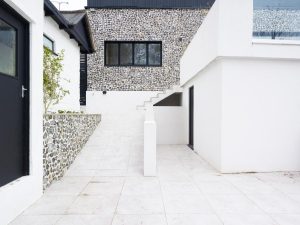
Expert tips for a successful SIPs Build
Make sure to work with designers who are familiar with SIP panel construction; this will help keep costs down, and get the maximum benefits out of the process.
Working within standard panel lengths, widths and heights is the most efficient way to get a building that will make the most out of the technology whilst giving you the maximum possible space.
To ensure your self-built SIP panel building is even more energy efficient and airtight, seal any vertical joints with an airtight tape. This was done with the self-build project at 95a Robinson Road, which ensured a closed system and very little thermal loss.
If possible, work with a company that provides everything in a single package, designing the panels, fabricating them, and erecting them onsite. Here at SIPs Eco, we’re with you at every stage of the process, from the initial design to the finished build.
And finally, interview various companies that specialise in SIPs construction. Choose a company that gives you the best balance between quality of product, value for money, and assistance throughout your self-build project.
In summary…
We hope that you have found this guide to self-building with SIP panels useful, and hope that any questions you may have had about this innovative construction method have been answered.
However, if you have any more questions about SIPs panels, please feel free to browse our Learning Hub, where more technical details can be found about the products themselves (such as our technical data sheets).
If you have a question that hasn’t been answered in this guide, please feel free to visit our FAQ hub, where more technical questions have been answered.
If you’ve heard enough and would like to take the first steps on your self-build project, please feel free to request a quote from us!
Download the PDF Contact Us